Handyman and Property Care on Stuart Island
Stuart is the far corner of the county — two small communities, a dirt road, a one-room school, and weather that arrives before it does anywhere else.
- Licensed & bonded
- WA L&I #SANJUJI741OT
- Insured
- Locally owned in Friday Harbor
The longest run I make
Stuart is the northwestern-most island in the county, out past Spieden and up against the Canadian border at Turn Point. From Friday Harbor it is around eleven nautical miles direct and realistically thirteen or fourteen as run, north up San Juan Channel and west through Spieden Channel. That is the longest crossing on my list and the one where timing matters most, because Spieden Channel runs hard and the water off Turn Point can be genuinely unpleasant on the wrong tide. I plan Stuart days around slack, which sometimes means an early start and sometimes means a different date.
Moorage is the one thing Stuart has plenty of. Reid Harbor and Prevost Harbor both hold state park docks and mooring buoys — several hundred feet of dock space between them and a couple dozen buoys — and the two harbors are well sheltered. From the water it is a walk or a cart ride up an unimproved dirt road that runs the length of the island. Cell service is spotty enough that I would rather agree the plan before I leave Friday Harbor than try to sort it out from your driveway.
To be clear about scope: I work on private homes on Stuart. I am not a contractor to Stuart Island Marine State Park and nothing on this page should be read as an offer to work on park property.
Exposed weather, and what it does to hardware
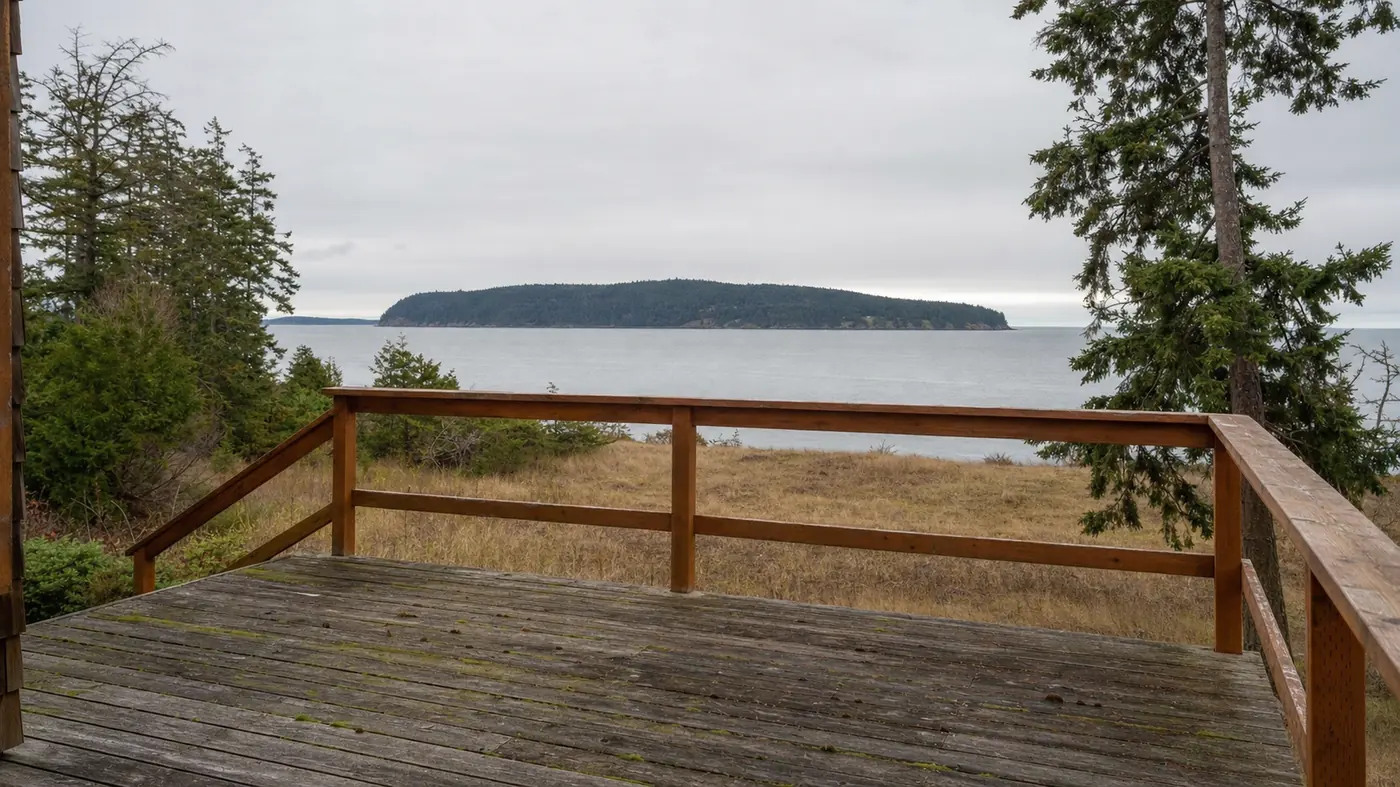
Stuart's housing is two clusters of full and part-time residents at opposite ends of the island, most of it modest and wood-framed, some of it decades old and added to in stages. There is a one-room schoolhouse the community built, with the original building kept as a small museum, and two airstrips. That is essentially the entire built environment.
What sets Stuart apart from the inner islands is exposure. It catches wind and salt from the west and northwest with nothing in front of it, and that shows up in a specific list of complaints. Exterior hardware corrodes fast: hinges, latch sets, sliding door rollers, screen frames, deck fasteners. Glazing gets etched and window seals go early on the weather side. Paint and stain on the west elevation fails in a fraction of the time it does on the east, and once it goes, the trim behind it starts taking water. Doors and windows on an unheated house swell and rack, so by spring the front door will not latch and one casement will not close.
That is why doors, windows, and trim is the service I actually get booked for on Stuart, more than anything else. It is also work that fits neatly in a skiff, which is a happy coincidence for an island this far out.
One more Stuart-specific fact worth planning around: there is no garbage service on the island. Whatever comes off a job goes back in my boat, and my boat holds one modest load. That is a real constraint on demolition work here and it belongs in the conversation before the day is booked, not after.
Mostly seasonal, and a long way from help
County planning figures put roughly 127 dwelling units on Stuart against 23 occupied year-round and a population near 52. Those come from the San Juan County comprehensive plan appendix, pairing 2000 census occupancy with 2005 unit counts — the most recent per-island public data, and not a current count. The shape of it is what matters: something like four out of five houses on Stuart are closed most of the year, on the island that is hardest for anybody to reach in a hurry.
That combination is the argument for property care rather than reactive calls. On Stuart the cost of a surprise is not just the repair, it is the crossing, and the crossing may not be available for a week if the weather is wrong. An owner who is here in July and gone the rest of the year benefits enormously from someone walking the property in the shoulder seasons: after the first real fall storm, and again before spring, with photographs and a straight account of what needs doing.
A standing arrangement also lets me batch. If I am running to Stuart for you, I would like to be running for two or three houses that day, which is exactly how the boat day rate is meant to be used on the far islands.
Material limits, honestly
My boat is a 16-foot skiff. It carries me, my tools, and small materials, and 20 feet is the honest ceiling on board length. On the longest crossing in my service area, I am also more conservative about what I load than I would be on a five-minute run. For Stuart, plan on repair-scale material: hardware, fasteners, trim, a door slab, small quantities of lumber, paint and stain, screen stock, roofing patch. Anything larger, and anything going out in volume, needs a barge, and on Stuart that is a real piece of coordination rather than an afterthought. If a project is not skiff-scale, I will say so and help you line up freight instead.
Questions I get about Stuart
Why does the tide decide my appointment time?
Because the run to Stuart crosses Spieden Channel and passes Turn Point, and both run hard. I schedule around slack water for safety and for a crossing that does not beat up my tools.
Can you haul away old material from a Stuart job?
Only a small load. There is no garbage service on the island, so anything removed leaves in my skiff, and that limits demolition work to what one boat can carry.
Do you work at the state park or the schoolhouse?
No. I work on private homes on Stuart. The park and the school are not my clients and I do not want to imply otherwise.
Next step
Work waiting on Stuart?
Send me the list and where I land, and I’ll quote the boat day before anything is booked. Call (360) 317-0203.
Related