Wood Rot Repair on San Juan Island
Rot is a water problem wearing a carpentry costume. I find the water first, then rebuild what it ate.
- Licensed & bonded
- WA L&I #SANJUJI741OT
- Insured
- Locally owned in Friday Harbor
This is the most common structural-adjacent problem on San Juan Island and the one most often left too long. Cedar siding, fir trim, eight months of wet, salt in the air, and a lot of houses that nobody looks at between October and June. That combination produces soft wood faster than most owners expect.
Rot is not really a wood problem. It’s a fungus that needs food, warmth, and water, and the only one of those three you get to control is the water. Wood-decay fungi stop working below roughly 20 percent moisture content and get genuinely active once wood is up around fiber saturation, near 28 to 30 percent, which is a condition our climate supplies for most of the winter wherever a detail lets water sit. That single fact drives how I work: if I replace a rotted sill and don’t fix what wet it, I’ve sold you the same repair again in three or four years.
So the first thing that happens is a diagnosis, not a demolition. I probe with an awl to find where sound wood starts, use a moisture meter on the surrounding material, and follow the water uphill. Nine times out of ten it’s one of a short list of things, and after enough houses out here the list is predictable: a gutter that has been overflowing behind the fascia for two winters, a downspout dumping against a skirt board, siding that sits too close to grade or hard down onto a deck surface, a horizontal trim board installed flat with no bevel and no drip edge, failed caulk at a window head, a deck ledger without proper flashing, or a post sitting directly on soil or on a slab that stays wet.
There is an island-specific pattern on top of that. Southwest-facing walls take wind-driven rain straight off the water and get soaked in a way a sheltered mainland lot never does. North-facing walls have the opposite problem: they never get enough sun to dry out, so they hold green film and moss and stay damp into May. Salt air keeps surfaces slightly hygroscopic and is hard on fasteners, so electroplated nails corrode, heads bleed, and every corroded nail hole becomes a path for water into end grain. Houses close to the water age their trim noticeably faster than houses a half mile inland, and I’ve seen the difference on the same road.
The places I find it, roughly in order: the bottoms of exterior door jambs and the casing beside them, window sills and the lower corners of window trim, the bottom course of siding, fascia behind a gutter, deck rim joists and ledgers, the base of posts and stair stringers, skirt boards, and the underside of bay windows and cantilevers. Interior rot shows up under exterior doors, at the perimeter of an unvented bathroom, and in crawlspaces where the vapor barrier has been dragged aside and never put back.
The repair itself is unglamorous and specific. I cut back to sound wood, generally six to twelve inches past anything that still feels soft, because the fungus runs ahead of the visible damage. I replace like with like — cedar for exterior trim and siding, pressure-treated where anything is within reach of ground contact — and I back-prime every piece on all six sides with particular attention to cut ends, because end grain is where the next round of water gets in. Fasteners are stainless or hot-dip galvanized, never electroplated, which is not a preference out here so much as a requirement. Joints get caulked where caulk belongs and deliberately left open where they need to drain, which is the detail most often gotten backward.
Epoxy consolidant has a place and I use it honestly: a small area of an original sill you want to keep, or a milled profile that can no longer be bought. It is not a substitute for replacing a rotted member, and anybody troweling epoxy into a soft jamb bottom and calling it done is selling you two years.
Matching material is the part that takes local knowledge. Browne’s in Friday Harbor stocks common cedar trim and dimensional stock, but an original 1970s profile usually has to be milled or run over on the ferry, and that changes the schedule more than the labor does. For outer-island work by skiff, 20-foot boards are the hard ceiling on a 16-foot boat, and anything longer or heavier goes by hauler or chartered boat at cost.
What I don’t do, plainly: roof replacement, roof-level flashing, and structural repair that changes how a building carries load. Replacing a rotted trim board, sill, siding run, fascia, or a rotted post base with like-for-like is inside a general contractor registration and inside my competence. If an awl sinks into a beam, a bearing post, or a floor joist carrying real load, that needs a permit and probably an engineer, and I will tell you that on the first visit rather than the third. If the water is coming from a supply line or a drain, a licensed plumber fixes that part before I touch the carpentry.
What’s included
- Moisture diagnosis and probing to find where sound wood starts
- Tracing and correcting the water source — gutter, downspout, flashing detail, grade contact, failed caulk
- Exterior trim, casing, sill, and skirt board replacement in cedar or treated stock
- Siding repair and course replacement, shingle and lap
- Fascia and rake board replacement where the gutter has been overflowing
- Door jamb bottoms, thresholds, and jamb leg replacement
- Deck rim joist, stair stringer, and post base repair
- Back-priming, end-grain sealing, and stainless or hot-dip fasteners throughout
- Photos of what was behind it, because you will never see it again
What it costs
Small rot repairs run on the standard $250 minimum visit, which covers two hours, then $85/hour in quarter-hour increments. Materials at cost plus pickup time. Washington sales tax applies to the total including labor. Full breakdown on the pricing page.
Larger rot work is quoted after I open it up, and I will not pretend otherwise. Rot is the one job where the estimate before demolition is a guess — you cannot see how far it went until the siding is off. What I do commit to is telling you the range up front, calling you before I go past it, and photographing everything I find.
For an empty second home, this is the strongest argument there is for a property care plan. A stain noticed in November is a caulk joint and an hour. The same stain found in June is a sill, a jamb, two courses of siding, and a paint job.
Full rate cardCommon questions
How do I know if I have rot or just weathered wood?
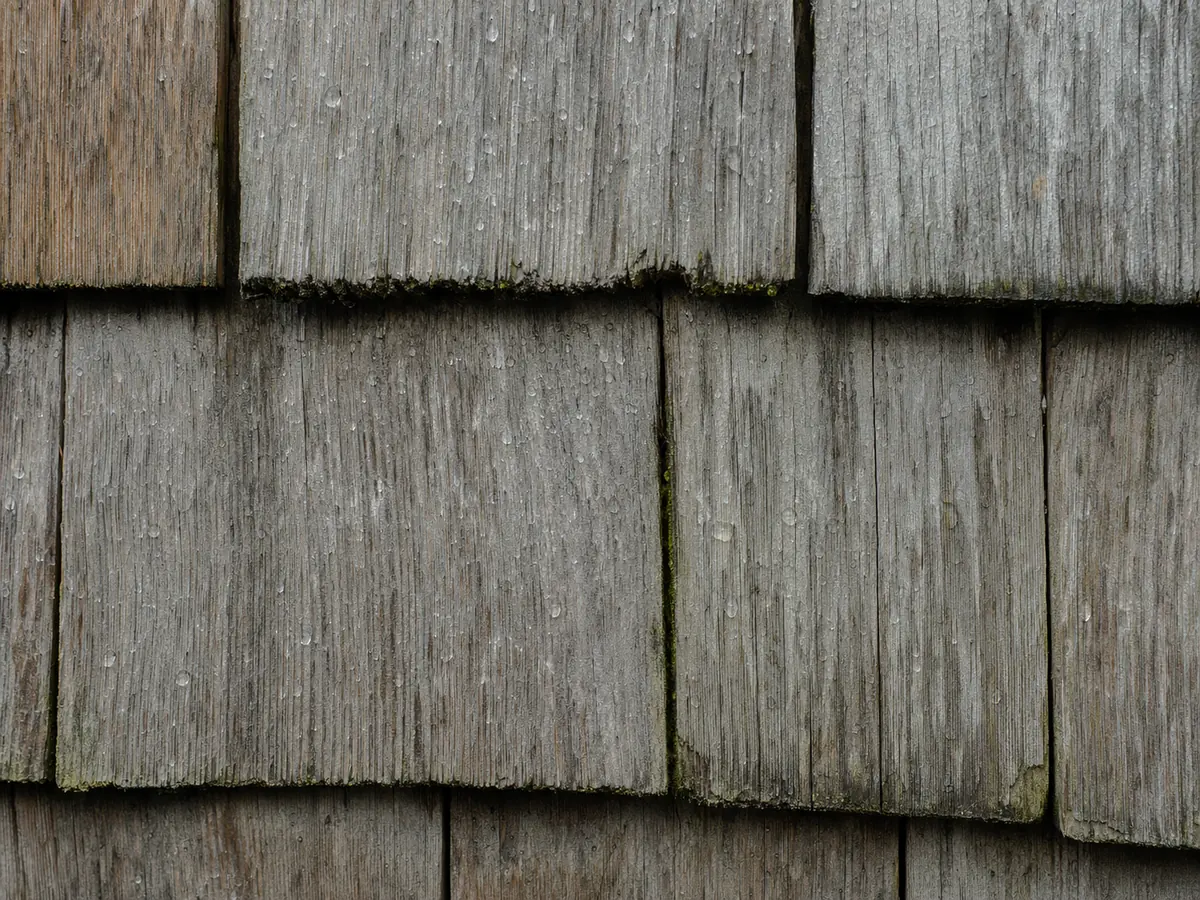
Press an awl or a screwdriver into it. Weathered cedar is gray and rough but hard. Rotted wood takes the point with almost no resistance, and often crumbles into cubes. If it’s soft at a joint, a sill, or the bottom of a jamb, assume it runs further than it looks.
Can you just fill it?
Sometimes, and I’ll say when. Epoxy consolidant is right for a small area of an original sill or a profile that can’t be bought anymore. It is not right for a jamb bottom that has gone punky. Filling active rot without fixing the water is a repair with an expiry date.
What time of year should this be done?
April through October is ideal, because primer and caulk need dry material and dry weather to work. Emergency repairs happen any month under a tarp, but the finish coat may have to wait for a dry stretch, and I’ll come back for it.
The rot is around a post holding up my deck. Can you fix that?
Post base repair and like-for-like replacement, yes. Anything that alters how the structure carries load, changes framing layout, or needs an engineer’s stamp is not my work. I hold a Washington general contractor registration, and I’ll be straight with you about which side of that line your deck is on.
Photo: Before / after pair of one rotted trim or sill section — awl sunk into soft wood, then the finished, primed replacement. Same angle.
Highest-value image on this page. The awl shot is the whole argument.
Photo: Open wall or removed siding course showing how far the damage actually ran past the visible stain.
Shot list item 8. Shows the diagnosis, not just the fix.
Next step
Want this off your list?
Call (360) 317-0203 or send the details and I’ll tell you what it takes.
Related