Interior Painting on San Juan Island
Ninety percent of a paint job is what happens before the lid comes off. That is especially true in a house that sits empty and damp all winter.
- Licensed & bonded
- WA L&I #SANJUJI741OT
- Insured
- Locally owned in Friday Harbor
Painting is the service where the difference between good and bad work is completely invisible on the day and completely obvious in two years. The paint is the cheap part. The prep is the job, and on an island house the prep has some specific problems that mainland copy never mentions.
Start with mildew, because it is the thing I find most often and the thing most often painted straight over. Interior walls on the north side of an island house, closet interiors, the wall behind a bed pushed against an exterior wall, and the corners of an unvented bathroom all grow it. A house shut up from October through May with no heat and no air movement will hold high humidity for months, and mildew does not need a leak to establish, only damp and stillness. If you paint over it, it comes back through the new coat, usually within a season, and now the failure is in your new paint film.
So mildewed surfaces get washed and treated first, then rinsed, then dried properly, then primed with a product that will hold. In a bathroom or laundry I use a coating rated for those conditions rather than the same flat wall paint used in the living room. Where the mildew keeps returning I will say plainly that the answer is ventilation and moisture control, not another coat, and I would rather have that conversation than take your money twice.
The second island problem is cure conditions. Paint does not cure below roughly 50 degrees, and it will not dry properly in a room at high humidity with the windows shut. In a second home that has been cold and closed since fall, I run heat and get air moving before I start, and I plan the schedule around it. That is why interior painting in a closed-up house in February takes longer than the same room in July, and why I will tell you when a job genuinely wants to wait for a better week rather than pretending the calendar does not matter.
The rest of the prep is the ordinary discipline that gets skipped: fill and sand the nail holes and dings, caulk the trim-to-wall joint where the house has moved, spot prime every bare patch and every stain with a stain-blocking primer so it does not flash or bleed, scuff-sand old glossy trim so the new coat actually bonds, and mask properly. Island houses move more than mainland houses with the seasonal humidity swing, so the caulk line at casing and baseboard opens and closes every year. Painting over an open joint just makes a painted open joint.
Finish choice matters more here than most places. Flat paint looks lovely and is a liability in a damp house with wood heat, because it holds dirt, it cannot be washed, and it shows every touch-up. For most island living spaces I recommend an eggshell or satin on walls, semi-gloss on trim and doors, and a proper kitchen-and-bath coating in wet rooms. For a vacation rental it is not close: washable finishes, darker or mid-tone scuff-tolerant colors in entries and hallways, and a labeled leftover gallon in the utility room so a mid-season touch-up matches. I leave the labels with the room name on them, because in five years nobody remembers which can was the guest bedroom.
There is a materials logistic here too. Browne’s in Friday Harbor carries paint and can match colors, but a specific line or a specific tint base may have to come over on the ferry, which is a day, not an hour. The practical consequence: I would rather order a little long than run out mid-wall, because a second batch mixed weeks later can show a slight difference on a long wall in raking light. Materials are billed at cost plus pickup time either way.
One honest limit. For houses built before 1978, federal rules govern who may disturb painted surfaces, and renovation and painting firms working in pre-1978 housing are required to be EPA-certified under the Lead Renovation, Repair and Painting rule. There is a fair amount of pre-1978 housing on this island. Before scraping or sanding painted surfaces in an older house I will tell you plainly whether your job falls under that rule and how it gets handled — that may mean a certified firm does the disturbance work. I will not quietly sand an old wall and hope nobody asks.
What I do not do is exterior repaints as a whole-house project, spray finishing of cabinetry in a booth, or wallpaper hanging. Exterior touch-up and trim painting that goes along with a repair, yes, in the dry season. Full exterior is a different trade rhythm and a different crew, and there are people here who do it well.
What’s included
- Walls, ceilings, trim, doors, and closet interiors
- Mildew washing and treatment before priming, not painting over it
- Filling, sanding, caulking moved trim joints, and spot priming
- Stain-blocking primer over water stains, knots, and smoke
- Finish selection for damp rooms, wood heat, and rental turnover
- Color matching and ordering through Browne’s or over on the ferry
- Furniture moved and covered, floors masked, cleanup at the end of each day
- Labeled leftover paint left on site by room, for future touch-ups
What it costs
Single rooms and touch-up work run on the standard $250 minimum visit covering two hours, then $85/hour in quarter-hour increments. Paint and materials at cost plus pickup time. Washington sales tax applies to the total including labor.
Multi-room jobs are quoted flat once I have walked the house, because the variable is prep, not square footage. A ten-year-old house with sound walls and a mildewed cabin of the same size are not the same job. Rates and how the minimum works are on the pricing page.
For ferry islands and outer islands, painting is priced on the island day rates. Painting is one of the better uses of a full day out there, because the drying time between coats fits inside the day rather than wasting a crossing.
Full rate cardCommon questions
Can you paint in winter?
Inside, yes, if the house can be brought up to temperature and I can get some air moving. Below about 50 degrees paint will not cure properly, and a cold damp closed-up house is the classic reason a coat stays tacky and marks for months.
The mildew on my north wall keeps coming back. Will new paint fix it?
Not on its own. New paint over untreated mildew fails from underneath. Treatment plus the right primer plus a washable finish buys you years. Fixing the ventilation and the crawlspace moisture is what actually ends it, and I’ll tell you which of those you have.
My house is from the 1960s. Does that change anything?
It might. Federal rules require firms disturbing painted surfaces in pre-1978 housing to be EPA lead-safe certified. I’ll tell you honestly whether your scope triggers it before we schedule, rather than after.
Do I need to be here?
No. This is common on second homes — a key or a code, colors agreed in advance, and photos as it goes. It pairs naturally with property care if the house is empty most of the year.
Photo: Cut line at a ceiling or trim edge, brush in hand, close in.
Shot list item 3. A clean cut line is the whole craft argument.
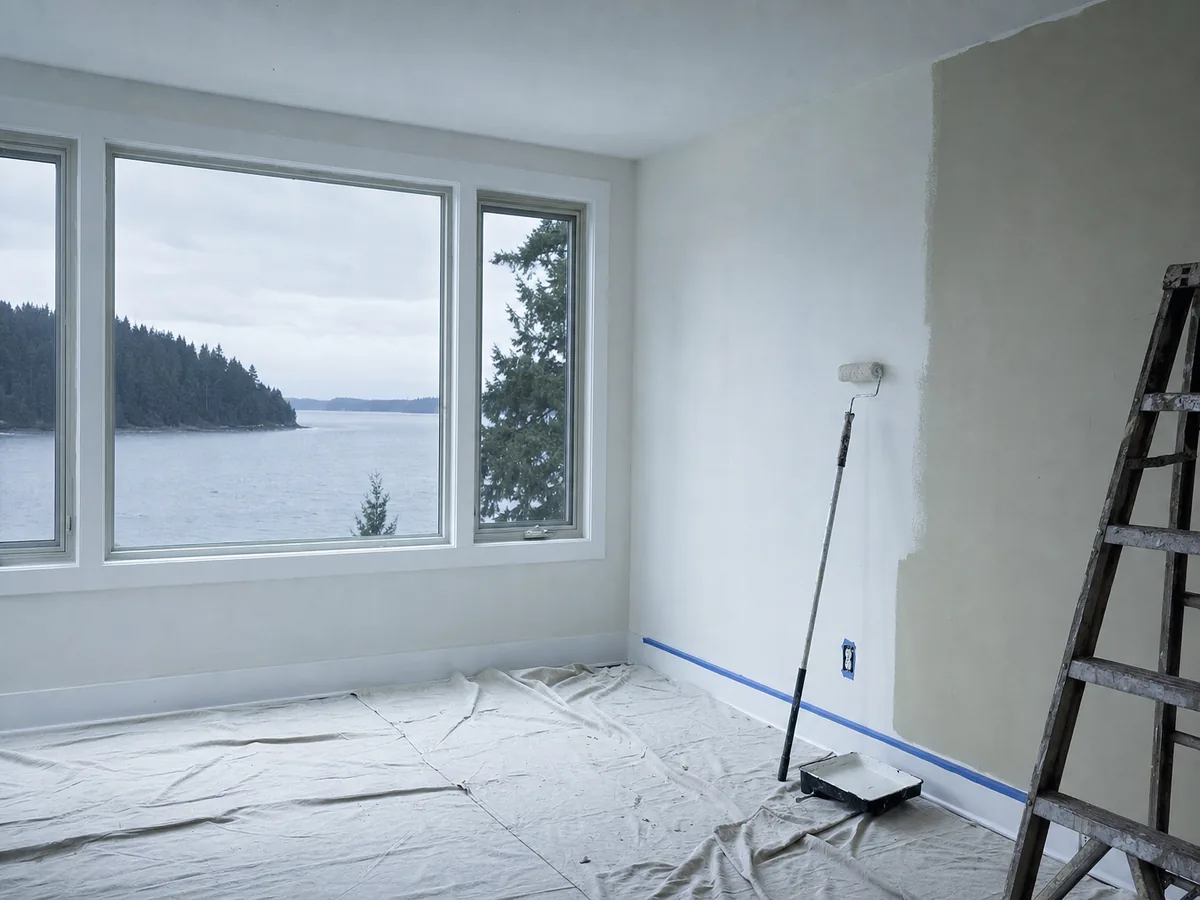
Photo: Prep shot — masked room, filled and sanded patches visible before paint.
Unusual and persuasive: shows the part clients never see.
Next step
Want this off your list?
Call (360) 317-0203 or send the details and I’ll tell you what it takes.
Related