Stair & Railing Repair on San Juan Island
A railing that moves when you lean on it is the most under-reported hazard in an island house.
- Licensed & bonded
- WA L&I #SANJUJI741OT
- Insured
- Locally owned in Friday Harbor
Stairs and railings get ignored until somebody nearly falls. They are also, in my experience out here, the most common genuine safety problem in an older island house — well ahead of anything else people worry about — because a lot of these houses were owner-built or owner-extended over decades, and the stairs got built to whatever felt right at the time.
The repairs themselves are mostly straightforward. A squeaking or loose tread is the tread having separated from the stringer, and where there is access from underneath the correct fix is glue blocks and wedges driven in from below, which is invisible and permanent. Where there is no underside access it is screwed and plugged from the top. Split and worn treads get replaced. Loose balusters get re-secured or replaced. A newel post that moves is the one that matters most, because the whole railing is only as good as its posts, and a loose newel usually means the connection at the bottom has worked free rather than the post being bad.
Exterior stairs have their own island version. Stringer bottoms that sit on soil or on a wet slab rot first, and moss on treads makes an outdoor stair genuinely dangerous by January. I replace rotted treads and stringer ends, add proper standoffs or a treated base where the wood was in contact with ground, and treat the moss. On the path-to-the-beach stairs that a lot of west-side and waterfront places have, the handrail is usually the neglected part and it is the one you need most in the wet.
Now the part I want to be straight about, because it is where honest advice matters. Current Washington residential code requires a guard where a walking surface is more than 30 inches above the floor or grade below, and residential guards are required to be at least 36 inches high, with handrails on stairs set between 34 and 38 inches measured vertically from the tread nosing. Guard infill is limited so that a 4-inch sphere cannot pass through. A great many older island houses do not meet any of that — 30-inch railings, balusters spaced wide enough for a toddler, and a deck stair with no graspable handrail at all are all things I see regularly.
Here is the honest position on that. An existing railing built to an older standard is generally not something you are required to tear out. But when I am replacing a railing, a guard, or a set of balusters, I build the new work to current geometry, because it costs nothing extra to do it right and because a low railing on an elevated deck above a rocky slope is a real risk, not a paperwork risk. If you have small grandchildren visiting a house with 6-inch baluster gaps above a 10-foot drop, I am going to tell you. What I will not do is quietly rebuild a non-conforming railing to the same non-conforming dimensions and call it a repair.
I also want to be clear about where my work stops. I hold a Washington general contractor registration, which covers repair and replacement of treads, risers, balusters, guards, handrails, newel posts, and stringer ends. It does not cover, and I do not offer, structural alteration: changing the rise and run of a staircase, relocating or re-cutting stringers to a new layout, cutting into or re-framing a floor opening, redesigning deck framing, or anything that requires an engineer’s stamp or a structural permit. Those jobs exist and they are legitimate work — they are just somebody else’s. If your stairs are too steep, if the headroom is short, or if the whole run needs to move, that is a design-and-permit project and I will tell you on the first visit rather than after I have taken money.
The reason that boundary matters practically on this island: San Juan County reviews and permits structural work, and getting an inspection scheduled here is not the same as calling one in on the mainland. Knowing in advance whether your job is a repair or a permitted alteration saves weeks. I would rather give you that answer for free than have you find out in June.
One more island-specific thing worth knowing. Salt air, and the fact that a lot of these railings live outdoors in weather eight months a year, mean fasteners are the usual failure point rather than the wood. Electroplated screws and old galvanized nails corrode, lose their grip, and stain the wood around them, and a railing that feels loose is often perfectly sound lumber holding onto dead fasteners. Rebuilt with stainless or hot-dip hardware and proper connectors, the same railing lasts decades. That is a cheap fix that people put off for years, which is exactly why it is worth calling about.
What’s included
- Squeaking and loose treads repaired with wedges and glue blocks from below where accessible
- Split, worn, and rotted stair tread and riser replacement
- Loose baluster and spindle repair and replacement
- Newel post re-securing and replacement
- Handrail repair, re-securing, and installation at a graspable height
- Guard rail repair and replacement built to current residential geometry
- Exterior stair repair, stringer end replacement, and moss treatment on treads
- Corroded fasteners and connectors replaced in stainless or hot-dip galvanized
- An honest read on whether your job is a repair or a permitted structural alteration
What it costs
$250 minimum visit covering two hours, then $85/hour in quarter-hour increments. A wobbly newel, a handful of loose balusters, and two squeaking treads are typically a single visit. Materials at cost plus pickup. Rate card.
A full guard or handrail replacement on a deck run is quoted as a project, because the material length and the connector detail drive it more than the hours do. On outer islands remember the 20-foot board ceiling on the skiff — longer stock goes by hauler at cost.
Full rate cardCommon questions
My deck railing wobbles. How urgent is that?
Urgent. A railing is the one part of a house whose entire job is to catch a person, and a wobbly one has already failed at it. It is usually a cheap repair — corroded fasteners or a loose post connection — and it is worth doing this month rather than next year.
My railing is only 30 inches high. Do I have to change it?
Not necessarily. Existing older work is generally left alone unless it is being replaced. But current residential code calls for guards at least 36 inches high, and if I’m rebuilding a railing I build the new one to that standard. If you have young kids visiting, I’d go further and say do it now.
Can you rebuild my staircase to be less steep?
No. Changing rise and run means re-cutting stringers and altering structure, which needs permits and often an engineer. That is outside what a general contractor registration covers me to design, and I’ll tell you that up front rather than halfway through.
Can you fix the squeak without ripping the stairs apart?
If I can get under the stairs, yes, and it’s invisible from the top. If the underside is finished, it gets screwed and plugged from above, and I’ll show you exactly what that will look like before I do it.
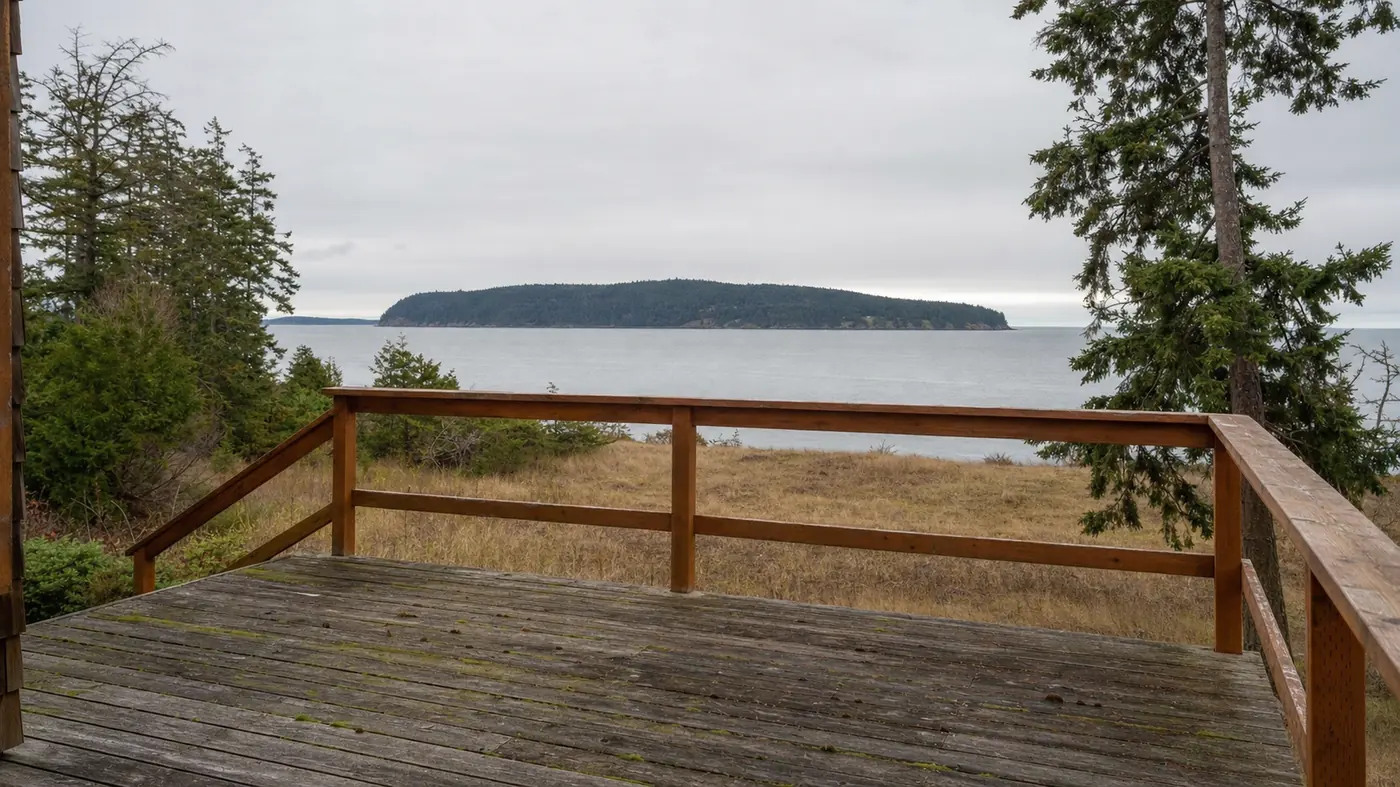
Photo: Hand on a rebuilt railing, deck and water behind it. Shows solidity.
Shot list item 3, with the island in the frame.
Photo: Stringer end repair on an exterior stair where the wood met the ground.
Pairs with the rot repair page.
Next step
Want this off your list?
Call (360) 317-0203 or send the details and I’ll tell you what it takes.
Related