Deck Staining & Sealing on San Juan Island
This page is about the finish, not the framing. Getting the finish right is mostly about prep and timing.
- Licensed & bonded
- WA L&I #SANJUJI741OT
- Insured
- Locally owned in Friday Harbor
If your deck has soft boards, a railing that moves, or a sagging stair, that is deck and fence repair and it comes first. This page is the other half of the job: the coating. What goes on the wood, how the wood gets ready for it, and when in the year it can actually happen.
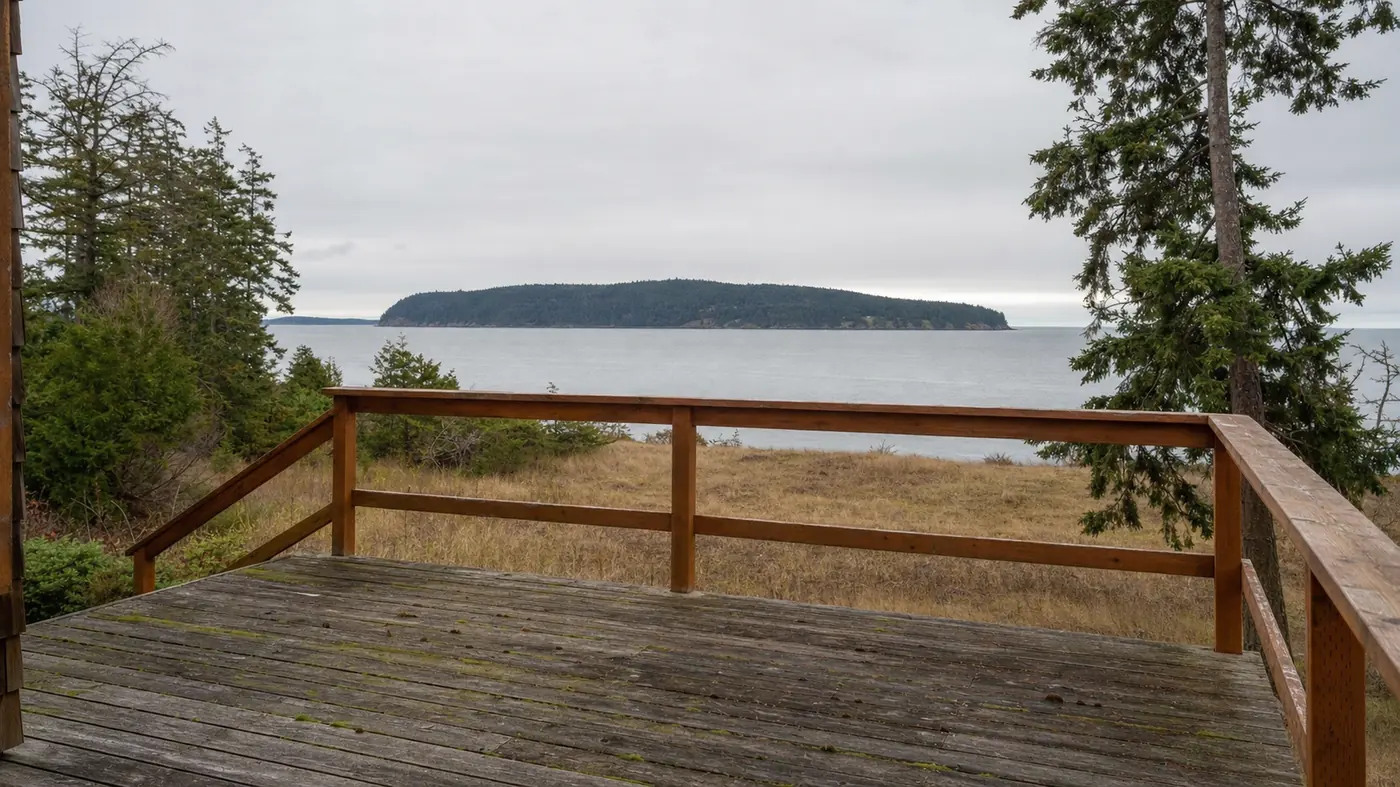
Start with why island decks fail unevenly. Walk any waterfront deck here and the south and west elevations — the boards nearest the open water, the top rail, the stair treads, the west-facing fascia — will be gray and open-grained while the sheltered corner by the house still has finish on it. That is ultraviolet and reflected light off the water, not rain. Meanwhile the north side of the same deck is holding algae and moss in the board seams, because it never fully dries between October and April. Same deck, two different failures, and a single coat of anything applied over both without addressing either will not last.
Prep is three separate steps and skipping any of them is the usual reason a finish fails early. First, clean: a percarbonate or sodium hydroxide deck cleaner to lift the biological growth and the gray dead wood fiber, agitated and rinsed, at low pressure. Pressure washing a cedar or fir deck at high pressure furs the grain and the stain then soaks in unevenly and blotches. Second, brighten: an oxalic acid brightener to neutralize the cleaner and bring the pH back down, which also pulls the black tannin staining out around the fasteners. Third, dry. Genuinely dry, all the way through the board, not dry on top.
That third step is where the island calendar bites. Friday Harbor is in the Olympic rain shadow and gets a real dry summer, but the useful window is narrow: roughly late May through mid-September, with July and August the only months you can plan on. A deck needs two to three consecutive dry days after washing before it takes a finish, plus dry weather after application. Boards that are shaded, tight-spaced, or over a damp crawlspace hold moisture much longer than the surface suggests, and I check with a moisture meter rather than a thumb. If it is not ready I will tell you and we move it, because staining damp wood is the single fastest way to waste the whole job.
On product I have a clear opinion for this climate. Penetrating oil finishes over film-forming ones, nearly every time. A film-forming stain or a deck paint sits on top of the wood, and in a climate where the boards take on moisture every winter, that film eventually lifts, cracks, and peels — and then you are into stripping or sanding, which is the expensive way to own a deck. A penetrating oil soaks into the fiber, wears off gradually rather than failing in sheets, and recoats by cleaning and reapplying. It needs doing more often, on a horizontal island deck realistically every two to three years on the sun-hit elevations and less on the sheltered ones, but each cycle is cheap and there is no failure mode where it has to come off.
If your deck already has a film-forming coating on it, say so before I quote, because that changes the job entirely. Recoating over a peeling film is not a repair, and stripping or sanding a full deck is its own project. On a deck that already has a solid stain on it and is otherwise sound, the honest recommendation is often to stay on the same system rather than fight it.
Railings and stairs get finished properly, not sprayed at from a distance. The top rail and the stair treads take the most water and the most wear and they are the parts anyone actually touches, so they get worked in by hand. Fasteners get checked while I am down on the boards — a corroded screw head on a waterfront deck is worth catching, and it is the sort of thing you only see when you are on your knees with a brush.
What’s included
- Deck cleaning to remove moss, algae, and gray dead wood fiber
- Brightening to neutralize the cleaner and pull tannin staining around fasteners
- Moisture check before any coating goes on
- Penetrating oil-based stain or sealer, applied and worked in
- Railings, top rails, balusters, stair treads, and fascia done by hand
- Popped or corroded fasteners flagged and re-set where straightforward
- Furniture moved and replaced, plants and siding masked
- A written note on which elevations will need recoating first, and when
What it costs
Quoted as a flat project. The drivers are square footage, how long it has been since the last finish, and whether the railing is a simple two-rail or forty balusters — balusters are most of the labor on a lot of decks. Materials at cost plus pickup. Washington sales tax applies to the total including labor. Full pricing here.
A small deck with a simple railing can land inside the $250 minimum visit plus $85/hour, but most island decks are a one- or two-day job split across the wash and the coat, because of the drying time in between.
Ferry islands run on scheduled island days: $595 half day, $995 full day. A deck refinish on Orcas or Lopez is normally two visits, since the wash and the stain cannot happen the same day. Outer islands by skiff are $1,295 for a full boat day.
Full rate cardCommon questions
How is this different from deck repair?
Repair is boards, railings, stairs, and fasteners. This is the finish that goes on top. If both are needed, the repair happens first so the new boards get coated with everything else.
Oil or a solid stain?
Penetrating oil, in almost every island case. It wears off instead of peeling off, so recoating is a wash and a reapply rather than a strip. Film-forming finishes look great for two years and then become a sanding project.
How long does it need to be dry first?
Two to three consecutive dry days after washing, and I check with a moisture meter rather than guessing. Shaded decks and tight board spacing take longer. If it is not ready I will reschedule rather than coat wet wood.
How often will it need doing again?
On the sun and water facing elevations, every two to three years. The sheltered sides go longer. You can often do just the elevations that need it, which is a much smaller job.
Photo: Before / after pair — the same deck section gray and open-grained, then cleaned and oiled. Same angle, same time of day.
Shot list item 6.
Photo: Hand-brushing the top rail, water in the background. Horizontal.
Shot list item 3.
Next step
Want this off your list?
Call (360) 317-0203 or send the details and I’ll tell you what it takes.
Related