Exterior Painting on San Juan Island
An exterior paint job out here is decided by prep and by timing — and on this island the timing is the harder half.
- Licensed & bonded
- WA L&I #SANJUJI741OT
- Insured
- Locally owned in Friday Harbor
Paint out here has a harder job than paint on the mainland. Salt carries inland on a southwesterly and settles on everything, so a surface that looks clean is often not. Winter rain arrives sideways, which means it hits vertical surfaces the way it never does inland. And then the summer sun on a south or west elevation with water reflecting back up at it will chalk a topcoat years before the north side shows anything at all. Almost every island repaint I look at is really two different jobs: two elevations that are failing and two that are fine.
The window is the other island-specific constraint, and it is genuinely narrow. Friday Harbor sits in the rain shadow of the Olympics and Vancouver Island, which is why we get dry summers and roughly half the rainfall of Seattle. That helps. But the useful painting season is still about May through mid-September, and July and August are the only two months you can count on. Most coatings want surface temperatures above the mid-fifties and dropping, not rising, humidity, plus dry wood underneath. I book exterior painting from the winter, and by June the good weeks are usually gone.
Prep is where the job is won. I wash first — soft washing, low pressure and a cleaning solution, never a pressure wand on painted cedar, because pressure drives water behind the siding and strips more coating than it cleans. Then scrape and sand the failing areas back to a sound edge, feather the transitions so you cannot read them from the yard, spot prime every bare spot, and caulk the joints that actually need caulk. Not every joint does. Sealing the bottom edge of a lap board or the underside of a shingle butt traps water in the wall, and I leave those to drain the way they were designed to.
Cedar needs one extra step that gets skipped constantly. Cedar contains water-soluble tannins that bleed straight through latex, and on bare or freshly exposed cedar you will get brown streaking within a season unless you use a stain-blocking primer. On a house that has already bled through, the old topcoat has to be washed and sealed before the new coat goes on, or you just paint over the problem and watch it come back. Knots and cut ends are the worst offenders.
Second homes have their own pattern. A house occupied three weeks a year goes eight or ten years between coats instead of six, and the failure is not evenly spread — it is concentrated on the water-facing elevations and the trim, especially horizontal trim, sills, and railings, which hold water. On those houses I will often recommend doing the two bad elevations and all the trim now, and the other two elevations in a later season. It is a smaller number and it is the right call, and I would rather say that than sell you a whole-house repaint you do not need yet.
A note on sheen and color that is specific to this light. West-facing walls here get direct evening sun plus reflected glare off the water, and a deep or saturated color on that elevation will fade visibly faster than the same color on the north side. Higher-sheen finishes shed dirt and salt better and clean off more easily, which is worth having on trim, sills, and anything at hand height, but they also show every ripple in old cedar. Flat or low-sheen on the body and a satin or semi-gloss on the trim is the combination that holds up and still looks right on a shingled island house. If you are choosing a color from a chip indoors, put a sample board up on the actual wall for a day first, because the light here will change it.
I paint the exterior of the building and its trim, doors, and outbuildings. I do not do lead abatement. Houses built before 1978 can have lead paint, and if testing suggests it, disturbing that coating is certified work and it goes to a certified firm. I will tell you plainly if your house is in that category rather than sanding first and mentioning it later.
What’s included
- Soft washing to remove salt, dirt, and biological growth before anything else
- Scraping, sanding, and feathering failed coating back to a sound edge
- Spot priming, plus stain-blocking primer on bare or bleeding cedar
- Selective caulking — joints that should be sealed, not the ones that should drain
- Body coats by brush, roller, or spray depending on the substrate
- Trim, fascia, corner boards, sills, doors, and railings
- Sheds, garages, and outbuildings in the same visit
- Minor cedar and trim repair identified before painting, not painted over
- Full masking, drop cloths, and a real cleanup
What it costs
Exterior painting is quoted as a flat project rather than hourly, because the variable is prep, not square footage. Two houses of the same size can be a week apart in labor depending on how much scraping there is. I walk it, photograph the failing areas, and give you a number. Paint and materials at cost plus pickup. Rates and minimums here.
Small work — one elevation, a door, a set of trim boards, touching up last year’s repairs — runs on the standard $250 minimum visit covering two hours, then $85/hour.
On Orcas, Lopez, and Shaw, painting is a full-day-rate job at $995 on a scheduled island day; half days at $595 rarely make sense for paint because of setup and cleanup. Outer islands by skiff are $1,295 for a full boat day, freight at cost on top.
Full rate cardCommon questions
When should this be booked?
In winter or early spring, for work in July or August. The reliable dry stretch here is short and it fills up. If you call in July for July, I will be honest about whether I can do it properly rather than start something the weather will ruin.
Why is my paint peeling on only one side of the house?
Almost always the south or west elevation, and almost always sun and reflected light off the water rather than rain. The shaded sides fail differently, usually with algae and moss in the shadow lines instead of peeling. Different problems, different fixes, and you often do not need to do all four sides at once.
Brown streaks came through my new paint. What happened?
That is cedar tannin bleeding through. It means the bare cedar went under a topcoat without a stain-blocking primer. Fixable, but it has to be washed and sealed first, not just recoated.
My house is from the sixties. Is lead a problem?
It can be. Pre-1978 houses may have lead paint, and disturbing it is certified work that I do not do. If the situation calls for testing I will say so up front and get a certified firm involved rather than start sanding.
Photo: Mid-job shot with a hard line visible — half the elevation prepped and primed, half still weathered.
Shot list item 8: visible improvement in a single frame.
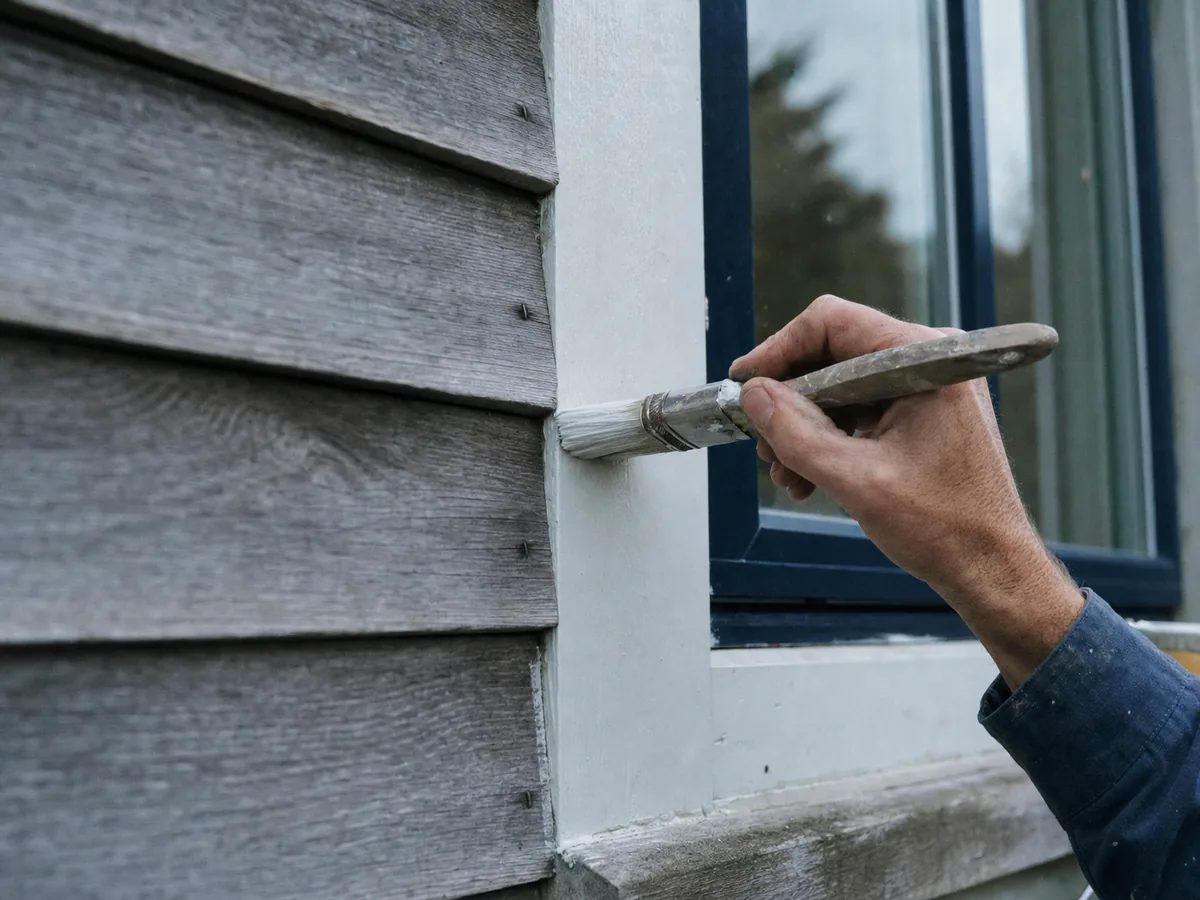
Photo: Brush loaded, cutting a clean line on trim against cedar. Close in, natural light.
Shot list item 3.
Next step
Want this off your list?
Call (360) 317-0203 or send the details and I’ll tell you what it takes.
Related