Furniture Assembly, Picture & Mirror Hanging on San Juan Island
Everything you own arrived here in a flat box. This is the visit where it becomes furniture and the art gets off the floor.
- Licensed & bonded
- WA L&I #SANJUJI741OT
- Insured
- Locally owned in Friday Harbor
Almost everything that comes to this island comes flat-packed, because flat is what ships economically to a place with a ferry in the middle of the supply chain. A sofa arrives in four boxes, a bed in nine, and a wardrobe in a carton two people cannot carry up a set of cabin stairs. I do a lot of these, and I do them in the order that keeps the piece square instead of the order printed in the booklet.
The part that actually costs people their weekend is a missing bag of hardware or a cam lock that stripped on the third turn. On the mainland that’s a trip to the store. Here it’s an email to a manufacturer and a two-week wait for a padded envelope to reach a Friday Harbor mailbox. I carry cam locks, dowels, threaded inserts, confirmat screws, and enough machine screws in the common metric sizes that I can usually finish the piece the same afternoon rather than leave it half-built in your living room.
Assembled furniture also has to survive being moved. Island houses get rearranged constantly — guest season, off season, the rental turnover, the winter shuffle of everything away from the drafty wall. Where a maker relies on a single cam lock to hold a case square, I glue the dowels. Where a bookcase or dresser is tall enough to go over, it gets an anti-tip strap into a stud, which is a two-minute job that manufacturers include and nobody installs.
Hanging is the other half of the same visit, and on an island house it is much less predictable than it sounds, because what is behind your wall depends entirely on when the house was built. The older houses in town run to lath and plaster, where a stud finder reads noise and the plaster keys break out around a screw if you drill dry and fast. The cabins built through the 1960s and 1970s are often tongue-and-groove cedar or fir over framing at 24-inch centers, sometimes with no drywall in the assembly at all, and sometimes with no consistent center spacing either because the framing was cut on site out of whatever came off the truck. Newer construction is conventional drywall over 16-inch centers, and that is the easy day.
So the first thing I do on a hanging job is figure out what I am actually screwing into. Magnets find plaster nails and drywall screws where an electronic finder cannot. Tapping and a small probe hole inside a closet or behind a door beats guessing. On paneling I read the nail lines. Then heavy things get lag screws or structural screws into framing, and things that must land between studs get rated toggles sized to the real weight rather than the anchor that came in the frame’s bag.
Heavy mirrors are where I push back hardest on what came in the box. A 60-pound antique mirror shipped with one sawtooth hanger stapled to a soft backing board is a mirror that will eventually come off a wall. Those get a French cleat spanning two studs, or a pair of D-rings on wire rated well above the actual weight, and they get set so the cleat carries the load down into framing instead of out through drywall. I also replace picture wire on anything that has hung near a water-facing wall for a decade, because salt air rusts the strands from the inside and a wire that looks fine snaps at the twist.
Gallery walls get laid out on the floor first, then transferred to the wall with paper templates and a laser line, so the wall takes one hole per hanger. Frames going above a woodstove or on an outside wall of a house that sits empty half the year need a little slack for movement, because seasonal humidity swings out here move plaster, paneling, and the frames themselves more than most people expect. Anything going up a stairwell gets a longer look at what is behind it, since that is exactly where the framing tends to be unusual.
One honest note about scope: this is small work, and the $250 minimum covers two hours. That makes it much better value as a batched visit. A bed frame, a dresser strapped to the wall, a mirror in the entry, and eleven frames in the hallway is one appointment. One nightstand is not.
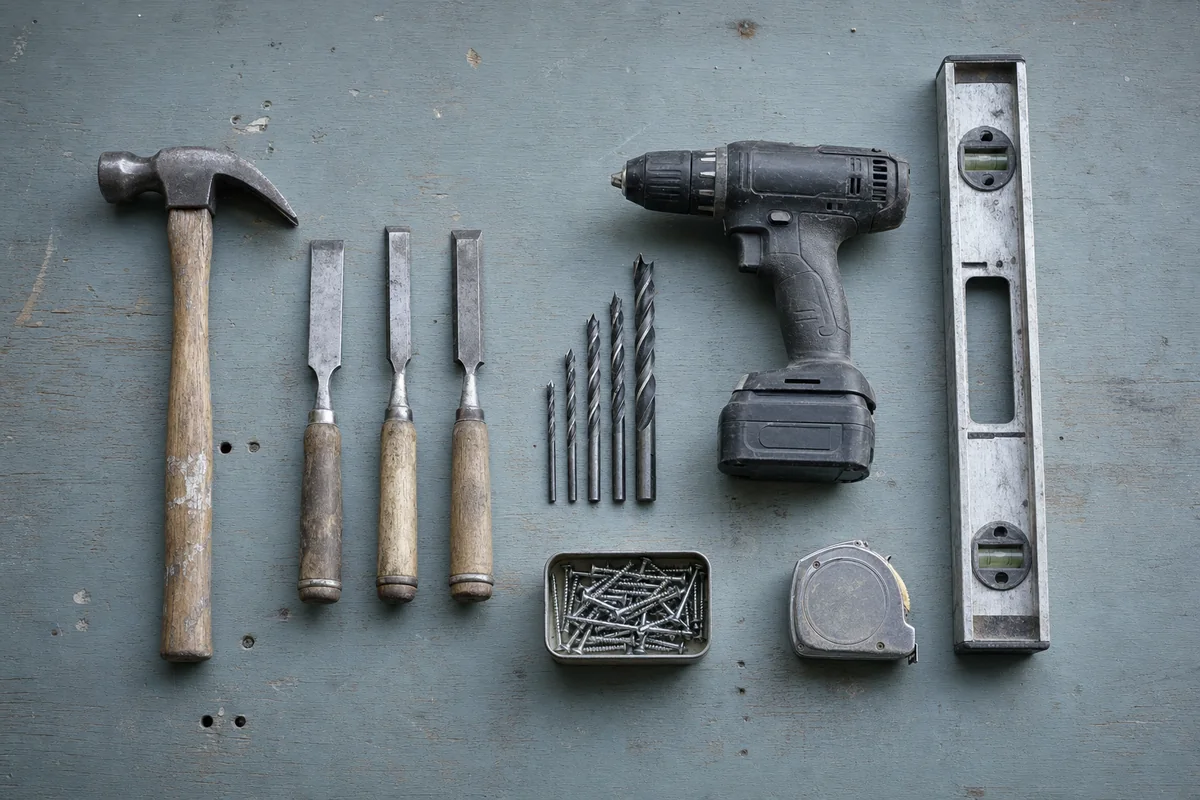
What’s included
- Flat-pack and knock-down furniture assembly, including beds, wardrobes, and shelving units
- Sourcing or substituting missing and stripped fasteners rather than waiting on a mailed part
- Anti-tip straps into framing on dressers, bookcases, and tall units
- Picture, frame, and gallery wall layout and hanging
- Heavy mirror hanging on French cleats or rated wire into studs
- Curtain rods, drapery hardware, and wall hooks
- Replacing corroded picture wire and undersized hangers
- Boxes, foam, and packaging broken down and hauled off
What it costs
$250 minimum visit covering up to two hours, then $85/hour in quarter-hour increments. Materials — cleats, anchors, straps, hardware — at cost plus pickup time from Browne’s. Washington sales tax applies to the total. See the rate card.
This is the category where batching pays most obviously. Two hours of an experienced pair of hands with a stud finder, a laser, and a full fastener kit covers a surprising amount of a list. Save it up, write it down, and leave it on the counter.
Full rate cardCommon questions
Can you hang a heavy mirror on a plaster wall?
Yes, and it is the most common version of this job in the older houses in town. Plaster over lath will hold a mirror if the fastener reaches the framing behind it. What plaster will not tolerate is a fast dry drill bit and an anchor sized by optimism.
The furniture is still in boxes in the garage. Is that a problem?
No, that is the normal starting condition. Leave the boxes near where the piece is going if you can, and tell me if any carton arrived crushed so I can check the panels before I build it into the room.
Do you charge extra to take the packaging away?
No. It goes out with me. Flattened cardboard from a full bedroom set fills a vehicle, which is exactly why it tends to sit in island garages for a year.
Photo: Hands setting a French cleat on a wall with a level across it, mirror leaning nearby.
Shot list item 3: action shots, hands on real work.
Next step
Want this off your list?
Call (360) 317-0203 or send the details and I’ll tell you what it takes.
Related